The Program
The multidisciplinary educational program adopt a float offers learners and educators from around the world the opportunity to explore the global ocean and discover why studying it is essential to better understand and protect our planet.
Two participation tracks allow learners to follow an underwater robot of the “profiling float” type: the Exploration Track and the Immersion Track.
Both tracks are free of charge and engage participants with science-based ocean topics through real ocean observation data and hands-on learning experiences.
Participation in any of the tracks requires registration. The Exploration Track offers a lighter registration process, whereas the Immersion Track involves a more structured commitment and extended participation throughout the school year.


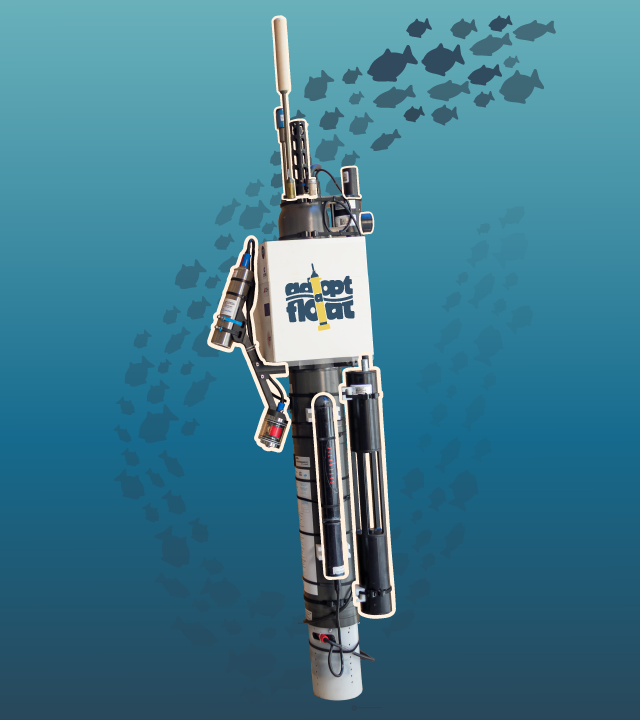
The Profiling Float
GPS & IRIDIUM ANTENNA
It provides the position of profiling floats in the Ocean and transmits their measurements.
OXYGEN SENSOR
Measuring the oxygen concentration provides information on the pathway and the age of a water mass in the Ocean. It can also be used to identify regions with low O2 content (the so-called Oxygen Minimum Zones, OMZs) where marine life is in danger.
SALINITY, TEMPERATURE AND PRESSURE SENSOR
Measuring temperature and salinity helps to identify the origin of waters and to understand currents and ocean circulation. The pressure sensor provides information about the depth at which all measurements were taken.
IRRADIANCE SENSOR
Measuring light levels helps to identify areas that are favourable for phytoplankton development.
PH SENSOR
Measuring pH helps scientists to monitor the phenomenon of ocean acidification.
CHLOROPHYLL a AND PARTICLE SENSOR
These measurements provide information on phytoplankton biomass.
UNDERWATER CAMERA
It observes and quantifies zooplankton, large phytoplankton and particles larger than 100 µm in a given volume of water.
NITRATE SENSOR
Measuring nitrates helps to identify areas that are favourable for phytoplankton development.
PARTICLES SENSOR (TRANSMISSIOMETER)
Measuring the concentration of particles (e.g. detritus) suspended in water provides oceanographers with information on carbon flux in the Ocean.
Intended to help to answer urging questions of oceanographers, the profiling float is a flagship robot of an international observation program of the Ocean. Today, there are several thousand of them deployed in the global ocean.
Equipped with miniaturized sensors and linked to a database fed in real time, profiling floats provide measurements of various physical (e.g. temperature), biological (e.g. oxygen) and chemical (e.g. pH) parameters between the Ocean surface and 2000 meters depth.
They are deployed from oceanographic vessels and voyage for several years. The profiling floats drift with the deep currents, yo-yo regularly within the water and when they ascend towards the surface, they take measures. Once back at surface, the collected data are transmitted by satellite and accessible in real time on an interactive map that scientists & classrooms share in use.
With these underwater robots, the adopt a float program undertakes a scientific outreach approach and works with schools. Thus, thanks to adopt a float, these robots, which are great scientific tools, also become modern and attractive teaching tools!
The Participation Tracks
Exploration Track
Through this track, participants follow Floaty, a profiling float selected by the adopt a float team. Each year, Floaty explores a different ocean basin.
The track offers lighter and autonomous access to real ocean observation data, selected educational resources, webinars, and ocean-related activities. It is designed for primary and secondary school levels, but can be used in wider educational contexts.
Immersion Track
This track offers deeper involvement through an extended educational journey. It includes float adoption, educational support, interventions, webinars, and encourages collaborative activities throughout the school year which concludes with a wrap-up session highlighting the work and projects developed by the classes.
The profiling float selected by the adopt a float team may already be deployed (or will soon be deployed) in the global ocean. Participating classes create a logo for the float, give it a name, and join the international Ocean Voyager community platform alongside other participating classes worldwide.
Designed for kindergarten, primary, and secondary school levels, the track provides the opportunity to meet and exchange with scientists and specifically encourages engagement with real ocean observation data.
Countries (and ocean basins) covered by the program vary from year to year depending on scientific collaborations and projects, research missions, and the availability of participating researchers as well as float deployment opportunities.